To avoid these ads, REGISTER NOW!

What kind of garage lighting did you choose?

Speed-Racer

Well-known member
Joined
Aug 25, 2008
Messages
731
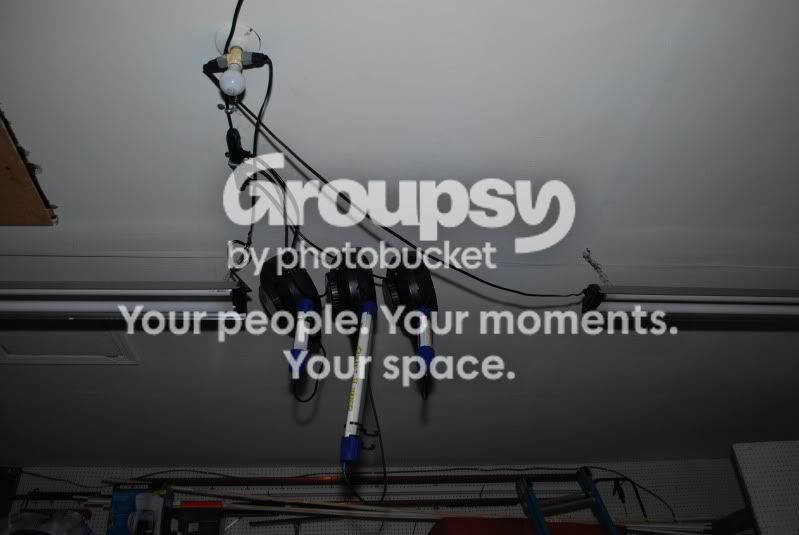
For my two car garage I need to upgrade the lighting, just mounted three work lights on reels and can see a huge difference when they are on. Of course when I am working on cars they are under the hood or suspension.

I have two fluorescent twin bulbs but need a better solution. Some garages on here have the metal Halide low bays, which seem to provide a lot of light vs. the T8. I have 9ft ceilings, many of the used Metal Halide lights are wired for 220v, can you rewire them for 110v?

What is in your garage and recommendation for a two car garage?


DSC_0479.jpg


DSC_0480.jpg


DSC_0478.jpg
 
Last edited:
To avoid these ads, REGISTER NOW!

cowboyjosh

Well-known member
Joined
Mar 11, 2010
Messages
1,066
first of all from a safety stand point, HARD WIRE everything in either pipe or MC cable; get rid of the temporary wiring in the pictures, the screw in socket adapters, extension cord, etc. I'd go with a T8 Florescent fixtures; they'll work in cold weather, easy to install, and put out a nice amount of light.
 
OP
S

Speed-Racer

Well-known member
Joined
Aug 25, 2008
Messages
731
I am in the process of running new wires to the garage. I was wondering about the Metal Halide lights and if you needed 220v for them. Do you have a good source for the T8 florescent fixtures, it would be nice to see them in person?
 

jwillis

Banned
Joined
Aug 24, 2010
Messages
5,225
Location
SW Ohio
I mounted two double floodlights on the ceiling in the middle of the garage pointing toward the rear and front of both cars in my two car garage. I put a rotary switch to control them. It really lights up the night. I will probably add two or four more down each side. I will probably go with fluorescents too, to cut down on the electric bill..........Good luck.........jwillis
 

fiveoh

Well-known member
Joined
Jun 23, 2009
Messages
68
first of all from a safety stand point, HARD WIRE everything in either pipe or MC cable; get rid of the temporary wiring in the pictures, the screw in socket adapters, extension cord, etc. I'd go with a T8 Florescent fixtures; they'll work in cold weather, easy to install, and put out a nice amount of light.

Whats the safety issue with having plug in light fixtures plugged in to a socket? I ask becuase the lights I use are the same way

I use 4 of these:

http://www.sears.com/shc/s/p_10153_12605_SPA8S138171211P?prdNo=3&blockNo=3&blockType=G3

plugged in to an outlet on my ceiling. I need the halogen lighting for detailing and these where the only resonable priced ones I could find.
 

ket-tek

Well-known member
Joined
Jan 28, 2009
Messages
1,289

Whats the safety issue with having plug in light fixtures plugged in to a socket? I ask becuase the lights I use are the same way

If your similar to the setup in the pic above, the two basic things I know off hand would be that 2-prong adapters are being used to eliminate the ground, which isn't preferable. There is a ground wire in the box under that bulb base, but a porcelain or plastic bulb base doesn't need a ground, the metal bodied florescent fixtures are designed to be grounded.

Also the bulb base fixtures have a current rating as they are designed to be used with a single 60w or maybe 100w bulb, and to much load from to many lights could easily exceed the rating.

One could remove the base and install an outlet or hardwire from that junction box and be within code for most places.

It's probally just fine and will never be an issue, but it's just not properly rated or up to code.
 

ket-tek

Well-known member
Joined
Jan 28, 2009
Messages
1,289
I have two fluorescent twin bulbs but need a better solution. Some garages on here have the metal Halide low bays, which seem to provide a lot of light vs. the T8. I have 9ft ceilings, many of the used Metal Halide lights are wired for 220v, can you rewire them for 110v?

What is in your garage and recommendation for a two car garage?
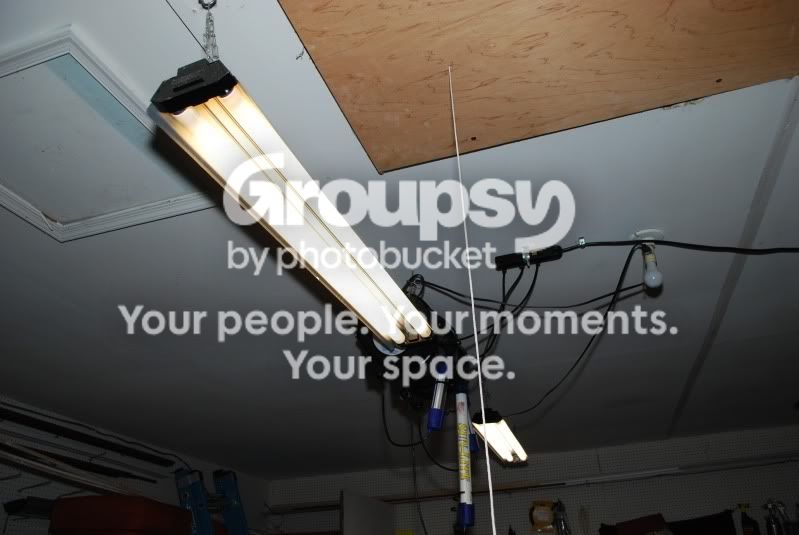
The hood on those fixtures seem to wrap pretty far around aiming most of the light down, more so than a normal reflector setup. Those type fixtures were meant for task lighting over a bench.

Metal Halides are gonna use a little more power, be more expensive for fixtures and bulbs, and also put out a substantial amount of heat from a 9ft ceiling, which may ok if your up north and it's cold most of the year.

The consensus is to go T8, they are affordable put out great light, start in cold weather better, and you have many color temperature choices and price ranges when choosing bulbs..

T5's are awesome but still pretty pricey these days.

Mounting T8's directly to the ceiling will give you better reflection than hanging them from chains, and getting them with either wider(flatter) or no reflectors will make a huge difference over what you have now.

For a two car garage I would say no less than 6-8 four foot twin bulb fixtures. Of course the more the better.

How many SQFT is the garage?
 

jvitez

Well-known member
Joined
Nov 30, 2009
Messages
2,429
Location
Big Sky Country, Canada
What, do you interogate people in that room! That's pretty bright for those CFL's. You do have a $h1tload of them though.

Is it safe? "Is what safe?" (obscure quote of the day....:))

Doing it this way would be pretty cheap from the light fixture standpoint. However, CFL's are still quite expensive here, maybe they're cheaper in other areas. Anything except the usual 13-23 watt ones get expensive fast. It would be an interesting calculation to pick a lumen level, and calculate the actual cost of fixtures/wire/bulbs using CFL's vs T8's.

Anyway, yes, it's a nice bright garage. Well done!
 

Norcal

Well-known member
Joined
Mar 16, 2008
Messages
13,754
I am in the process of running new wires to the garage. I was wondering about the Metal Halide lights and if you needed 220v for them. Do you have a good source for the T8 florescent fixtures, it would be nice to see them in person?

In the US voltages in excess of 120 volts is prohibited in a residence, & 220V is not a domestic voltage & has not been so in 60-70 years.With the low ceiling in a garage MH lighting is not really a good option, T8 strips or wraparounds will be the best choice, IMO for a garage MH is not a good idea unless one has high ceilings and then your stuck w/ warm up times & cool down time while waiting after a power failure w/ metal halide.
 

Gwhizman

Member
Joined
Mar 5, 2008
Messages
20
Location
Atlanta GA
4' florsent overhead and under cabinet (only one bulb to buy)
 

Attachments

  • Jam2006 050.jpg
    Jam2006 050.jpg
    146 KB · Views: 195
  • P1020346.jpg
    P1020346.jpg
    73.7 KB · Views: 125

trythis

Well-known member
Joined
Dec 6, 2009
Messages
348
Location
st louis
In the US voltages in excess of 120 volts is prohibited in a residence, & 220V is not a domestic voltage & has not been so in 60-70 years.

Nothing prohibited about 220V. If you wanted to wire your whole house with 220, no-one would stop you. You would have to get all your appliances and such from Europe, but stranger things have happened. People ship cars, why not hair dryers, oh wait those can run on 220, so can my computer.

We have 220 ovens, dryers, stoves, AC units, and overhead lighting could be 220V if you wired them that way.
The plugs are different so you cant plug a 110 into a 220v outlet.
Heck you could wire 3phase in your house if you want to. It would cost a fortune, but no law I know of that says you cant.

Am I wrong here? enlighten me
 
Last edited:

Norcal

Well-known member
Joined
Mar 16, 2008
Messages
13,754
Nothing prohibited about 220V. If you wanted to wire your whole house with 220, no-one would stop you. You would have to get all your appliances and such from Europe, but stranger things have happened. People ship cars, why not hair dryers, oh wait those can run on 220, so can my computer.

We have 220 ovens, dryers, stoves, AC units, and overhead lighting could be 220V if you wired them that way.
The plugs are different so you cant plug a 110 into a 220v outlet.
Heck you could wire 3phase in your house if you want to. It would cost a fortune, but no law I know of that says you cant.

Am I wrong here? enlighten me

First thing there is NO such thing as 110,220 in the US and any reference to those obsolete voltages means someone has not read any appliance data plates.

And to answer your statement "Nothing prohibited about 220V." there is NEC section 210.6(A) that says otherwise. Here is a copy & paste from the 2008 NEC:

(A) Occupancy Limitation. In dwelling units and guest
rooms or guest suites of hotels, motels, and similar occupancies,
the voltage shall not exceed 120 volts, nominal,
between conductors that supply the terminals of the
following:
(1) Luminaires
(2) Cord-and-plug-connected loads 1440 volt-amperes,
nominal, or less or less than 1⁄4 hp

If one has a attached garage to a residential /dwelling unit,that limitation would be in effect, if detached then it would be subject to a wider interpretation.


(Italics & bold type by me).
 
To avoid these ads, REGISTER NOW!

e-tek

Well-known member
Joined
Dec 19, 2007
Messages
10,690
Location
Saskatoon, SK
When I did all my work in my 2-car garage, I installed extra Flourescent fixtures (4foot) over the stall and along the side. I just ran the wire on the drywall with wire holders, then when I built and moved to the big shop, I was able to easily remove it and fill the small holes.
You can see the one on the wall in this photo:

27220002.jpg
 

Jeremy W

Well-known member
Joined
Aug 27, 2010
Messages
95
technically speaking it's 240 volts but everyone considers it 220, just like a normal household outlet is 120 volts but people consider it 110. 240 or 220 as people call it is still used for hot water heaters, dryers,ranges, and is what the mane feed coming into houses. It has been for years..............
 

mark250

Member
Joined
Sep 19, 2010
Messages
6
I recently got power to my shop and the lights I am using are t8 fixtures that are 8 feet long. Right now I have seven installed and soon there will be eleven more to go up.
 

meissen

Well-known member
Joined
Aug 10, 2010
Messages
944
Location
Macomb, MI
In the US voltages in excess of 120 volts is prohibited in a residence, & 220V is not a domestic voltage & has not been so in 60-70 years.

:headscrat :wtf: I can think of 3 separate 240 volt outlets I have around my house...


On the subject of the garage lighting - my biggest confusion is do the fluorescent light fixtures come with a normal plug or do I have to custom wire it? I see a ton of fluorescent fixtures on craigslist but I never see a cord attached. The previous owner put about 8 single bulb halogen fixtures around the perimeter of the garage - I really want to change them to something that will provide more light.
 

porcupine73

Well-known member
Joined
Jan 22, 2008
Messages
576
Location
Buffalo, NY USA
I went with those four foot dual bulb fluorescent fixtures from Home Depot because the price was right. I got one box of warm bulbs and one box of cool bulbs and use one each in each fixture (though in the future I'd probably use just the cool whites). The cost of say ten of those fixtures and bulbs isn't too much, they give a good amount of light, and are somewhat efficient.
 

bill9860

Well-known member
Joined
Jan 25, 2010
Messages
162
Location
Northern VA
Got 12 2 bulb T5 4' Lithonias from Home Depot (Lithonia # 256442 or HD # 453824) used 4100K bulbs. All the light I need for my 26'W x 28'L w/12.5' ceiling (mostly). In fact, I had them wired to 2 switches working 6 each so that I can have only 6 come on when doing stuff like sweeping/general clean up....anything not requiring a lot of light.
 

Opel

New member
Joined
Oct 1, 2010
Messages
2
My garage is about 19' x 20' and right now, all I have are 2x twin 4' T8 fixtures. That light is supplemented by the light from the garage door opener, two 26W CFL bulbs.

It's adequate lighting; though only about 0.55W per square foot. But, I'd like to add more... I was considering two more twin fixtures at the very least, for a total of four. I simply don't know right now - but I do know I gotta replace the lame "outlet" that used to have a single light bulb in it with a proper electric outlet.
 
Last edited:

trythis

Well-known member
Joined
Dec 6, 2009
Messages
348
Location
st louis
First thing there is NO such thing as 110,220 in the US and any reference to those obsolete voltages means someone has not read any appliance data plates.

I just use 220 as a common way of saying 240, I am not suggesting any exact voltage
And to answer your statement "Nothing prohibited about 220V." there is NEC section 210.6(A) that says otherwise. Here is a copy & paste from the 2008 NEC:

(A) Occupancy Limitation. In dwelling units and guest
rooms or guest suites of hotels, motels, and similar occupancies,
the voltage shall not exceed 120 volts, nominal,
between conductors that supply the terminals of the
following:
(1) Luminaires
(2) Cord-and-plug-connected loads 1440 volt-amperes,
nominal, or less or less than 1⁄4 hp

If one has a attached garage to a residential /dwelling unit,that limitation would be in effect, if detached then it would be subject to a wider interpretation.


(Italics & bold type by me).

I stand enlightened, or sit.

However, I wouldnt give a poop and my city inspectors wouldnt know or care if I wanted 220V, er excuse me :) 240V lamps installed in my connected shop, which is in an old warehouse, I would just install em.

My wife and I bring European light fixtures from Denmark back home and rewire them, and re-socket them for US use, but for any industrial stuff I find, I would just run a 240 circuit.

Also, NEC isnt necessarily the law in area X, localities seem to pick their own regs. The NEC is a trademarked set of standards created by the National Fire codes people, not a legal entity and I have lived in places that are operating on decades old versions of the NEC and not to the letter of it then either.


Anyway, to answer OP,

I used some old lighting fixtures and installed new F96T12HO ballasts and of course new bulbs! I have a 2000 sq foot shop and 6 fixtures so far. They are 120V btw.

I have 3phase in my alley and consider getting it hooked to the house but the extra $$ to have it connected and monthly fee doesnt make sense yet.

As far as that NEC rule goes:

How do they think people are going to run 5HP table saws and planers and big welders without 240V???
 

Eljefe640

Member
Joined
Jan 6, 2010
Messages
12
Location
Austin, TX
As far as that NEC rule goes:

How do they think people are going to run 5HP table saws and planers and big welders without 240V???

the voltage shall not exceed 120 volts, nominal,
between conductors that supply the terminals of the
following:
(1) Luminaires
(2) Cord-and-plug-connected loads 1440 volt-amperes,
nominal, or less or less than 1⁄4 hp

.

I haven't ever seen a 240v welder that was under 1440vA.

I have a question about European voltages, my understanding is that they use a 50Hz, 230/460v system. Meaning that one hot to neutral will give you 230v. Assuming that frequency was not an issue, would a European 230V appliance work on north American 240V power?

Now back on topic. I installed qty 6, 8', T8 strip lights in my garage. I chose fixtures that use qty 4, 4' lamps though instead of 8' lamps. The garage is roughly 32x25 and they work very well. Sadly I don't have any pictures to post. I'll fix that...
 

deathbound

Well-known member
Joined
Feb 6, 2010
Messages
280
Location
Long Beach, California Uber Alles
technically speaking it's 240 volts but everyone considers it 220, just like a normal household outlet is 120 volts but people consider it 110. 240 or 220 as people call it is still used for hot water heaters, dryers,ranges, and is what the mane feed coming into houses. It has been for years..............

"220, 221, whatever it takes."
 

driver

Well-known member
Joined
Mar 16, 2010
Messages
126
I haven't ever seen a 240v welder that was under 1440vA.

I have a question about European voltages, my understanding is that they use a 50Hz, 230/460v system. Meaning that one hot to neutral will give you 230v. Assuming that frequency was not an issue, would a European 230V appliance work on north American 240V power?

European industrial voltages are 330V/660V 50Hz what they call "delta/star" connection. We work with electrical motors made in Europe and the stators used for US 460V 60 Hz are the same ones as 330V 50Hz, however the dual voltage stators for 230/460 60Hz are different.
 

trythis

Well-known member
Joined
Dec 6, 2009
Messages
348
Location
st louis
I haven't ever seen a 240v welder that was under 1440vA.

I have a question about European voltages, my understanding is that they use a 50Hz, 230/460v system. Meaning that one hot to neutral will give you 230v. Assuming that frequency was not an issue, would a European 230V appliance work on north American 240V power?

Back off topic, My mother in Law is Danish, Her Copenhagen apartment is wired in 3phase...or something (its all in Danish and she knows less about Danish electrical systems than I do)

I say that because all the breakers to the appliances have three switches ganged and a 4th wire running into the system. So a neutral I guess.

and as for the NEC, and my house/shop, I dont they they have jusrisdiction as they arent a government regulator. My locality might care, but I doubt it, we dont have occupancy permits here. One of my neighbors lives in a building that is zoned industrial, he can do anything short of processing nuclear waste if he wants to.
 
Last edited:

sixball

Well-known member
Joined
Dec 4, 2009
Messages
149

I'd Like some feedback on this. I have the same sockets spaced about the same in my garage, but they are hooked up to some failing old 4 foot tube shop lights.

What kind of bulbs are those? Does it light better than 4 foot dual tube shop lights? What about energy cost? Are those more expensive to run VS 4 footers?

I gota make a change in my garage

Thanks
Sixball
 

popcorn-guy

Active member
Joined
Sep 6, 2010
Messages
25
Location
Sonoma County, CA
In my new shop that has a 14 ft. ceiling I have eleven fixtures with 6 ea. 4 ft. lamps that are T8's and three fixtures with 2ea lamps that are T8's as well. These fixtures are "high bays" and are hard wired and hung approx. 12 inches below the ceiling to be lower than the steel beams and not block their reflectance. On the second floor the fixtures are hung between 10-12 ft, which is about the lowest one can go with high bays. There are six hung for about 2/3 of the available space as the last 1/3 will be addressed as an office which has a completly different requirement due to computers and other office equipment. The high bay lamps are rated at 5000 K and when I turn them on, even in the daytime, it's amazing to have such good lighting. I chose the T8's over the T5's due to intial cost and the fact that as a small shop owner that doesn't use it on a regular basis I wasn't saving anything significant to warrant the T5 set up. They both have an incredible amount of useful hours so I am happy that I will not have to be climbing tall ladders or putting up scaffold to change them often.

I believe it would be important to make sure that one purchase the correct style of fixture for the height of their ceiling in order to get the proper dispersment of the lighting. I am prepared to also add task lighting over each piece of machinery as even though their is a ton of light, when one works over, say a lathe, their person will cast shadow and imho that means that it is more difficult to do good work.

The CFL's shown in the previous photos are a unique approach. I did note that one of the issues of a garage with an overhead door is the blocking of lighting fixtures and if one wants to have the door open in the evening the lighting becomes a lot less, especially if you are working under the door. If a canister style door could be obtained for the usual 7 ft high opening of a residential door, and it's appearance be acceptable, it would be a solution to that issue. As for the CFL's and their costs vs the T8/T5's I would think that one would have to look up the rates and energy requirements to answer that question. Part of what I did for the T5 vs T8 application and then determine what one is willing to invest in. I do know one thing, that really good light is well worth the investment, especially now that I for once have that good light.
 
To avoid these ads, REGISTER NOW!
Top Bottom