Hi Chris,
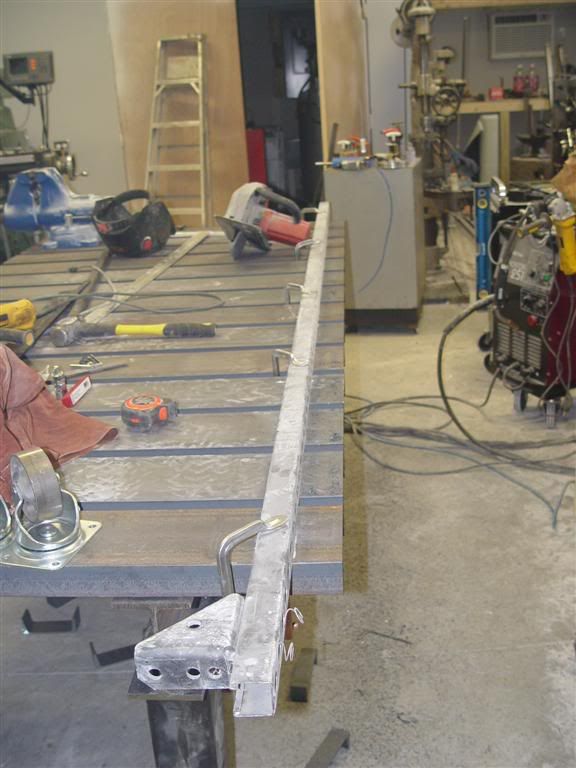
I made a small setup table for TIG. I used the Milwaukee 9" (I think, it's been a while since I've used it, I use my plasma for 99% of stuff now) dry circular saw. I made it small, as I stuffed a small toolbox in the frame underneath it. I copied the design from a member on WeldingWeb, but his name escapes me at the moment. I had it blanchard ground at a place about 350 miles away for, if I remember correctly, around ~$200. It's a small table, around 20"x48 because I got a great deal on that piece that was a drop. I was really hoping for 2'x4' but.. I just couldn't pass up the other one. It ended up working out well, as it's very easy to setup and reach across. I really don't miss those 4" (Never thought I'd say that!). I drilled/tapped/countersunk on 4" centers. I went with 1/2-13 because Bridgeport step-block sets are usually 50% the price of any other type(size). I believe I have 2 sets of the cheapie Imported sets from Use-Enco.com when they went on sale for about ~$15 dollars per 30-40pc set. A few 1-2-3 blocks, 90 degree plates, etc.. and you can jig pretty much anything.
I use short countersunk pan head screws to plug the holes flush with the top. I keep a few long ones threaded through the outside 2 rows on the perimeter because those aren't kept out of the elements by the toolbox / frame. I douse each one with copper anti-sieze to keep the holes coated, so the bolts don't seize in the holes with grinding dust / slag / heat. It took a while, but I set the stop on my magdrill for each step, then did each hole step by step.
I don't know if it would be faster to pilot drill all the holes, then go back and full-size drill them all, then go back and powertap each one, then go back and countersink them all. I did each hole at a time. 1/8" pilot, 3/16", then 27/64", powertapped, then countersinked. I used a caliper to set the cs depth each time.
It took a long time to do, but not nearly as long as if I did it by hand. I used lots of lube and went slow. My 1/8", 3/16", and 27/64" drills made it through unscathed without resharpening, as did the cs bit. If I were to do it again, I would have bought a 1-size under annular cutter, then reamed the hole to size to tap. I think I would have been done in half the time if I did it that way. In all, I think I'm ~500 into it. Most of that was the top box stuffed inside of it, and the fasteners / jig clamps. Truthfully, though.. my 2'x4' roll around with a 1/4" top gets used more, as I don't jig that often. But when I do, the table is indispensable! Doing header modification, or building turbo manifolds from scratch, it's real easy to keep everything on the same plane or perpendicular. It's also used for valve cover modifications, cast aluminum repair or anything with a flange that needs to be kept straight and flat. I've written a novel, I'm sorry. I have insomnia and it's 4:50am my time. My SO just gave me another dirty look, it's time to go back to bed, HA. 'Night




 some really informative posts and cleared up a lot of the questions that i was going to ask! haha, one of the other things i was wondering was what type of blade to use? as some people are saying different materials and i am no expert believe me! i am considering maybe diamond material? what's everyone's thought's?i was thinking maybe these <a href="http://www.ftisupplies.co.uk/" style="text-decoration:none;" "color:black;">diamond blades</a> from fti supplies. any help would be great! thanks