To avoid these ads, REGISTER NOW!

Adding 220V outlet to a 100A Box

z28snksknr

Well-known member
Joined
Jul 8, 2009
Messages
1,827
Location
Turnersville, NJ
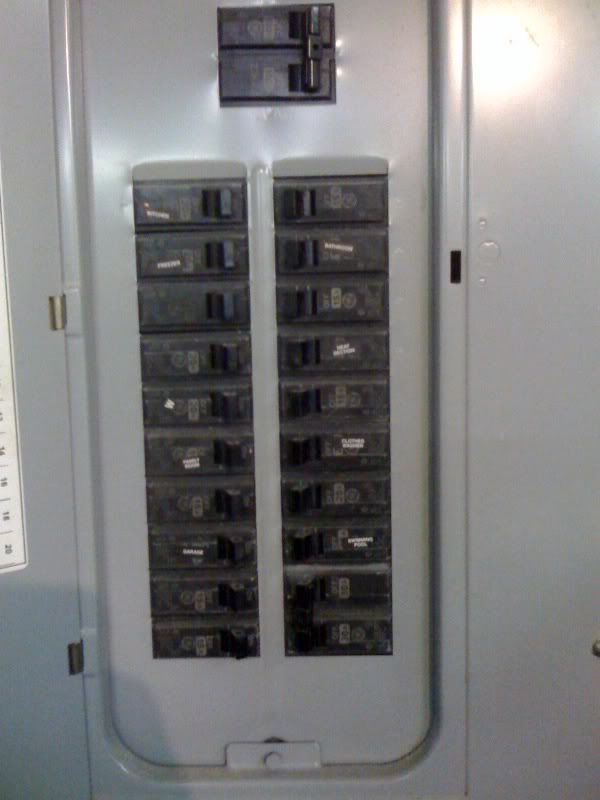
Here is a pic of my panel:

photo-1.jpg


As you can see, the panel is filled. I want to know what would be involved (if it would even be recommended) to add a 220V breaker to the panel for a welder / air compressor.

First question:
If I have 100A service and there is already a 60A breaker for the HVAC, is it unwise to add another 60A breaker? I'm picturing my AC running in the middle of the summer and I start working with the welder and..... bad things?

Second question:
I've seen people both for and against fitting those double breakers in one slot to free up space for additional circuits. Can anyone explain the down sides of doing this? If it's accepted by code, why do some oppose it?

Third question;
Since I don't have any prior experience working in a panel (but have a good understanding of wiring), what is a good procedure for 1)Making room in the panel by adding 2 double breakers and 2)Adding a 60A double breaker for a 220V outlet that will be located right under the panel in the garage wall?

:bowdown:Thanks in advance.:bowdown:
 
To avoid these ads, REGISTER NOW!

saabman

Well-known member
Joined
Oct 8, 2009
Messages
594
Location
Sebago Lake, Maine
I am no electrician, but before upgrading to a 40 slot 200 amp panel my house had a 100 amp fused service. To gain a little extra space a mini sub box was added (prior to my ownership) to the panel and mounted adjacent to it.

Chris
 

Charles (in GA)

Well-known member
Joined
Jan 11, 2006
Messages
12,489
Location
50 mi south of Atlanta
That label, to the left, just out of the pic, on the inside of the panel door, probably has a list of part numbers of approved GE Breakers that can be installed in this panel. It also probably specifies (or shows in the illustration) which breaker positions will accept the "double" breakers, and which will not. The stabs in the positions that accept the double breakers have a notch cut in them that allows the breaker to be pushed fully into place. Ones without the notch prevent the double breaker from being inserted.

Charles
 
OP
Z

z28snksknr

Well-known member
Joined
Jul 8, 2009
Messages
1,827
Location
Turnersville, NJ
That label, to the left, just out of the pic, on the inside of the panel door, probably has a list of part numbers of approved GE Breakers that can be installed in this panel. It also probably specifies (or shows in the illustration) which breaker positions will accept the "double" breakers, and which will not. The stabs in the positions that accept the double breakers have a notch cut in them that allows the breaker to be pushed fully into place. Ones without the notch prevent the double breaker from being inserted.

Charles

Thanks for the info. I would have never known that if it wasn't pointed out.
 

Charles (in GA)

Well-known member
Joined
Jan 11, 2006
Messages
12,489
Location
50 mi south of Atlanta
I need to correct something I posted earlier. The Siemens panel has the notches in the stab that allow the installation of Siemens double breakers. On GE panels (which I see you have as evidenced by the GE main and branch breakers), the 1/2 width and the double breakers have a special type of clip that connects with small u shaped pieces welded to the sides of the stabs. If the stabs do not have the extra u shaped contacts, there is nowhere for the 1/2 width and double breakers to connect. Again, the decal on the door should give you a clue to which do and which do not.

Charles
 
Last edited:
To avoid these ads, REGISTER NOW!

AZ Garage

Well-known member
Joined
Sep 23, 2009
Messages
82
Location
Mesa AZ
OP needs to do a load service calculation before proceeding much further.

With a 60A HVAC breaker, even at %80 capacity, it is pulling in half the amps of the panel.
 

Red Green

Well-known member
Joined
Dec 5, 2007
Messages
1,905
Location
South Central Michigan
Is the HVAC breaker the one in the bottom right? That looks to be a 30amp breaker to me.

I agree with AZ Garage about the load calulation.

Also I have my welder on a 30amp breaker and it has never triped.
 
Last edited:

5030tinkerer

New member
Joined
Nov 19, 2009
Messages
2
As you can see, the panel is filled. I want to know what would be involved (if it would even be recommended) to add a 220V breaker to the panel for a welder / air compressor.

Adding another breaker is easy, but you are correct in that you'll first have to add space. Of course, adding it is only easy if this panel is on an unfinished wall, otherwise you will of course be cutting into sheetrock to run the wires necessary.

If I have 100A service and there is already a 60A breaker for the HVAC, is it unwise to add another 60A breaker? I'm picturing my AC running in the middle of the summer and I start working with the welder and..... bad things?

Your 60A HVAC almost certainly doesn't pull 60 amps. It's common (and perhaps code) for breakers to be sized such that the load does not exceed 80% of the breaker rating, or 48 amps. To find out what your HVAC actually draws, review the documentation or check the actual draw with an amp meter. It may also be that your 60A breaker is in place to handle strip (backup electrical) heat. If this is the case, your summertime concern isn't a concern at all.

Regardless, if you exceed the 100 amps rated by the panel, all that will happen is that your main breaker will trip. I wouldn't personally worry about it. If you are that concerned, or if you find that your main is tripping all the time, one option would be to just shut off your HVAC when you are trying to weld. I wouldn't at all worry about an air compressor unless it, too, pulls 60 amps 220.

I've seen people both for and against fitting those double breakers in one slot to free up space for additional circuits. Can anyone explain the down sides of doing this? If it's accepted by code, why do some oppose it?

Couldn't tell you. I don't see a problem with it, so long as you are careful to evenly distribute the intended load to both 110 power legs. If you don't know what I am talking about, look at the copper main bus in the back of an open panel at your home improvement store and note that the copper lugs that the breakers tie into feed back and forth such that breaker #1 ties to one copper bus and the breaker in the full slot immediately under it ties into the other leg, etc.

Since I don't have any prior experience working in a panel (but have a good understanding of wiring), what is a good procedure for 1)Making room in the panel by adding 2 double breakers and 2)Adding a 60A double breaker for a 220V outlet that will be located right under the panel in the garage wall?

First step, ESPECIALLY if you don't have experience working in a panel, would be to drop power to the feed serving the panel. Just shutting off the 100 amp main breaker doesn't kill power to the panel, just to the main bus that the other breakers tie into.

Touch the feed wires you are installing to that 100 amp main and you're toast. Think it's completely hard to do? Hardly. I like to use electrical tape to cover the lugs of the main to give myself added insurance against a wire hitting against a lug on accident.

After you shut off power to the panel, go ahead and for good measure shut off the 100amp breaker on this panel, too. You don't need some well intentioned but ultimately misguided person turning power on the feeding panel while you're working. :shocking:

Then, pop in a few of the double, single pole breakers to make the room you need, terminating the black (hot) wires to the new double, single pole breakers. Now would be a good time to think about NOT putting too much load on any one 110 leg (see above).

Next, feed in the properly sized wire into the panel, terminating the ground and neutral as required, and lastly the two hots. Tighten the lugs a reasonable amount, but don't go crazy. Assuming you've already terminated the wires on the outlet end, you're set. Leave the newly installed breaker off, go turn on the feed panel, come back to this panel and turn on the 100 amp main, and then flip on the new service breaker.

I remember the first time I wired a 100 amp sub panel being so concerned about getting fried that I had my wife at the ready with a wooden handled broom stick ready to push me off the panel. Crazy. It's really very, very easy. Just take your time and you'll be fine.

:bowdown:Thanks in advance.:bowdown:
No problem.
 
To avoid these ads, REGISTER NOW!
Top Bottom