|
Welcome to the The Garage Journal Board forums. You are currently viewing our boards as a guest which gives you limited access to view most discussions and access our other features. By joining our free community you will have access to post topics, communicate privately with other members (PM), respond to polls, upload content and access many other special features. Registration is fast, simple and absolutely free so please, join our community today! If you have any problems with the registration process or your account login, please contact contact us. |
|
|||||||
![]() |
|
Thread Tools | Display Modes |
|
|
#1 |
|
Senior Member
Join Date: Jan 2010
Location: Portland, ME
Posts: 100
|
So I've read a bunch of threads on concrete here and on other sites, but I'm still left with some questions. Could anyone please help me?
I have some very basic questions about re-doing the concrete on my garage floor. It was probably done in the 1950s/1960s, the garage measures approx. 20'x20'. The concrete looks pretty aggregate-heavy, and is starting to crack and crumble in some spots. It seems to have been poured as two separate pours, as opposed to one big pour with relief cuts. Anyway, right now I'm just trying to run the numbers to see what it would cost to re-do the concrete. I would try and do all the prep myself (up to and perhaps including the forms), and then have someone come and pour it & finish it. * Does my soil and water determine whether or not to use a vapor barrier, or are they always good practice? * Does my plan to heat the garage determine whether or not to use rigid foam insulation underneath, or something else? * Is 3"-4" of gravel/stone underneath sufficient for a typical pad pour? * What determines whether or not my pad needs footers around the perimeter? My ultimate plan is to epoxy the floor, so I think that means "yes" to a vapor barrier. But I don't know about the gravel/stone question, or even what kind of gravel/stone to use. |
|
|
|
|
|
#2 |
|
Senior Member
Join Date: Dec 2010
Location: Indianapolis, Indiana
Posts: 674
|
* Does my soil and water determine whether or not to use a vapor barrier, or are they always good practice?
Always good practice, especially if the garage is a level area. If you can find some real vapor barrier material instead of the cheap visqueen, you would be better off. 15 mil is a good start. * Does my plan to heat the garage determine whether or not to use rigid foam insulation underneath, or something else? If heating, for sure. If not even then it will help contain what heat you have in the space. * Is 3"-4" of gravel/stone underneath sufficient for a typical pad pour? Yes. the biggest thing is to make sure it is compacted well. The best type of granular fill is crushed stone with a graduated size of 1.5" to fines. This compacts real well. Don't do the pea gravel, that invites moisture. Sand is tough to keep in place and moves around a lot when placing concrete making an uneven sub surface. gene |
|
|
|
|
|
#3 | |||
|
Senior Member
Join Date: Jan 2010
Location: Portland, ME
Posts: 100
|
Quote:
Quote:
Quote:
Also, I'm not sure if I'm going to epoxy the finished floor or not. If I do, then I'm going to want a broom finish on the pad, right? And if not, a smoother finish? |
|||
|
|
|
|
|
#4 |
|
Senior Member
Join Date: Dec 2010
Location: Indianapolis, Indiana
Posts: 674
|
If a trowel machine is used, have them use their float finish blades and trowel as smooth as they can without "burning" the surface. this will leave you a smooth finish without glazing the surface. Final finish is determined on what you are going to do to the concrete. If you are not interested in an epoxy application, you may want them to burnish it tighter. (with trowel blades). if you want the surface open some, then the float blades.
The 2" standard rigid Styrofoam board is good to use.
__________________
Director of Training and Tech support: Gene Dean Training Schedule:http://www.elitecreteindiana.com Email:info@elitecreteindiana.com Tel:317-888-4440 |
|
|
|
|
|
#5 |
|
Senior Member
Join Date: Jan 2010
Location: Portland, ME
Posts: 100
|
The styrofoam goes on top of the compacted stone base, right?
Last edited by numbah9; 06-23-2012 at 06:43 PM. |
|
|
|
|
|
#6 |
|
Senior Member
Join Date: Dec 2010
Location: Indianapolis, Indiana
Posts: 674
|
You have to dig out the area so the top of the foam is level with the fill. This will ensure you have a consistant thickness of concrete.
|
|
|
|
|
|
#7 |
|
Senior Member
Join Date: Jan 2010
Location: Portland, ME
Posts: 100
|
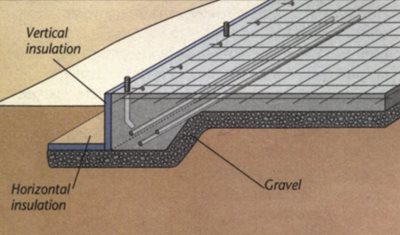
Thanks. Given my climate, I'm going to need to pour like this right? Because the load of the structure is supported on the edge of the foundation.
|
|
|
|
|
|
#8 |
|
Senior Member
Join Date: Dec 2010
Location: Indianapolis, Indiana
Posts: 674
|
Are you putting your insulation to the outside? Most all pours I've done, the rigid board is on the inside. I can't see any disavantage in this. Interesting.
We use this on masonary constructed slabs. Intalled on the inside of the block on the vertical plane and then lay the barrier flat toward the center of the slab, even with the bottom of the concrete. |
|
|
|
|
|
#9 |
|
Senior Member
Join Date: Jan 2010
Location: Portland, ME
Posts: 100
|
I used that mainly to show the difference in thickness between the middle of the slab and that of the perimeter. I thought the insulation placement was strange, too!
I like to learn how to fish, instead of just buying fish. |
|
|
|
|
|
#10 |
|
Senior Member
Join Date: Dec 2010
Location: Indianapolis, Indiana
Posts: 674
|
Is this a monolithic pour? Meaning, footers-slab poured together?
__________________
Director of Training and Tech support: Gene Dean Training Schedule:http://www.elitecreteindiana.com Email:info@elitecreteindiana.com Tel:317-888-4440 |
|
|
|
|
|
#11 |
|
Senior Member
Join Date: Dec 2010
Location: Indianapolis, Indiana
Posts: 674
|
If I'm seeing this correctly, the contractor will form the outside perimeter of the slab. Then apply the rigid foam to the inside of the form. I don't know how he is going to put the horizontal piece in or for that matter if it will do much good. If that's the case, have him form it 4" wider and double up the 2" of rigid board vertically. That will give you the best insulation.
__________________
Director of Training and Tech support: Gene Dean Training Schedule:http://www.elitecreteindiana.com Email:info@elitecreteindiana.com Tel:317-888-4440 |
|
|
|
|
|
#12 |
|
Senior Member
Join Date: Jan 2010
Location: Portland, ME
Posts: 100
|
Monolithic would be ideal, but I doubt that is possible. The structure has rotting sills, and has a slight lean, so it will need to be jacked up in order for me to fix the sills.
I imagine trying to bust up the old floor and re-pour the whole thing (slab and footers) monolithically while the building is jacked would be impractical. The thread I started about the structure itself is here, but all the pictures are gone. I'm working on fixing those! Last edited by numbah9; 06-23-2012 at 08:20 PM. |
|
|
|
|
|
#13 |
|
Senior Member
Join Date: Dec 2010
Location: Indianapolis, Indiana
Posts: 674
|
With the pics provided I'm kinda lost on how to help with what you say above. It's not that hard to figure out where to place the insulation. Just look at it this way. Try to get the rigid board as deep as possible on the vertical and 2 foot horizontal to the inside of the building. Set it at level with the subgrade.
|
|
|
|
|
|
#14 |
|
Senior Member
Join Date: Jan 2010
Location: Portland, ME
Posts: 100
|
Yeah, that makes sense. I think I was overcomplicating it!
Do you think the existing slab could be saved, or would it be easier to bust and replace? |
|
|
|
|
|
#15 |
|
Senior Member
Join Date: Dec 2010
Location: Indianapolis, Indiana
Posts: 674
|
Photos?
|
|
|
|
|
|
#16 |
|
Senior Member
Join Date: Jan 2010
Location: Portland, ME
Posts: 100
|
Gene, you can see them in this thread: http://www.garagejournal.com/forum/s...ad.php?t=91743
Let me know if you want me to take some more. |
|
|
|
|
|
#17 |
|
Senior Member
Join Date: Jun 2008
Location: Manitoba Canada
Posts: 569
|
I am in Manitoba, With my slab (monolithic pour)the building designer / engineer specified 1.5" Polystyreen under the slab but not under the thickened edge, vapour barior on top of the whole base, 2" Polystyreen verticle around the whole slab and horisontal around the outside of the slab (as in your picture) to reduce the amount of frost working it's way under the slab.
__________________
Here is a link to my "I'm not sure what to call it build" http://www.garagejournal.com/forum/s...ad.php?t=94224 |
|
|
|
|
|
#18 |
|
Senior Member
Join Date: Dec 2010
Location: Indianapolis, Indiana
Posts: 674
|
The couple of pics of the concrete looks like it's shot. gene
|
|
|
|
|
|
#19 |
|
Senior Member
Join Date: Jan 2010
Location: Portland, ME
Posts: 100
|
Well, this is embarrassing, but it turns out the garage doesn't sit on the slab at all. It actually sits around it! It's like they put the building down, then poured the slab after. So the sills sit on soil (and a bit of rock here and there).
Does that change my best course of action? |
|
|
|
|
|
#20 |
|
Senior Member
Join Date: Dec 2010
Location: Indianapolis, Indiana
Posts: 674
|
Well, you need a footing system. You could jack it up to support the walls and hand dig a footer and pour that. In the Indy area an unattached garage requires 18" deep footer. That doesn't mean the concrete has to be 18" deep. The bottom of the footing does. Pour it up to allow for 1 or 2 courses of block. It's slow going for sure. I've done a few of these when I was younger. I've dug out and put basements under homes too. That was no fun either. gene
|
|
|
|
![]() |
| Thread Tools | |
| Display Modes | |
|
|