To avoid these ads, REGISTER NOW!

Steel Tube Joint - Need your help

JDishong

Well-known member
Joined
Jun 2, 2012
Messages
358
Location
Prosper, Texas
I need some advise from you machine-shop types ...

Problem: I need to join 2 identical OD/ID steel tubes ( end-to-end ) so the total length of the combined tubes is adjustable by a few inches. This would be similar to telescopic tubes but I must use identical tubes in this application.

Idea#1: Machine shop to create swedge end on one tude so it becomes like a telescopic joint. This is not ideal since it adds cost to the manufacturing.

Idea#2: see drawing below. This is a concept I thought might work but lack the knowledge of what it is called. It looks like a possible solution but I would like to research it by name .. any advice on what this style/type of joint is called ??? any other suggestions on how to make a similar combiner joint?

tube%20slide%20joint-XL.jpg


Thanks!
 
To avoid these ads, REGISTER NOW!

metaleltr

Well-known member
Joined
Sep 4, 2009
Messages
2,680
Location
Western Ohio
What about a sleeve? It could be either internal or external. Close fitting piece which could be welded in place to join them, unless it need to be removable. Then you may be able to just weld half the sleeve and slip fit the other half.
 
OP
J

JDishong

Well-known member
Joined
Jun 2, 2012
Messages
358
Location
Prosper, Texas
I probably should have stressed the point about cost-sensitive .. these are $2 - 3 dollar tube pieces. Welding not an option due to price.

Thanks for your thoughts though
 

619DioFan

Well-known member
Joined
Apr 9, 2013
Messages
3,617
Location
San Diego , Ca.
Not sure what guage tubing you are using but if it is similar to exhaust pipe p/u an exhaust pipe expander tool ( harbor freight has them ) slips into one end , crank down on it to expand the tube so the other one can slip inside.
 

retrobuilder

Well-known member
Joined
Oct 18, 2012
Messages
408
Location
Alpharetta GA
sleeve it on the inside or outside. Rivet one end with 2-3 rivets around the tube or braze (diy).

What size tubing?? material? aluminum or steel

We do this method on low cost aluminum towers for boats. www.fishmaster.com
 

theoldwizard1

Well-known member
Joined
Feb 22, 2011
Messages
43,218
Location
SE MI
I probably should have stressed the point about cost-sensitive .. these are $2 - 3 dollar tube pieces. Welding not an option due to price.

Swage.

The best "home made" one I've seen used a 2 piece die set (2 pieces of 1/2" steel) attached to an air hammer/chisel in some kind of frame. Lube the tube. one person runs the air hammer while the other turns the tube.
 

Flatland Dave

Well-known member
Joined
Jan 1, 2010
Messages
1,363
Location
SoDak
I'd say this is a problem in a mfg situation, not a garage project problem if time to weld two pieces together is a concern?

I'd guess friction welding is out too?
 

Tink

Well-known member
Joined
Aug 26, 2009
Messages
285
Location
Old Bridge,N.J.
Probably need more information. Do the inside and outside diameters have to be the same size? Would it be possible to let us know the application of this product?
 

Flatland Dave

Well-known member
Joined
Jan 1, 2010
Messages
1,363
Location
SoDak
You guys keep missing the key point

Ok, so how about a thread-able insert, or must it be the same diameter the whole length of the piece. and the ends are fixed.

Another thought would be to have a sleeve with a pin through the inner piece which rides in a slot in the outer tube.

Details, we need details!!!:lol:
 

bczygan

Well-known member
Joined
Nov 4, 2009
Messages
22,002
Location
DETROIT! Arsenal of Scrappers
You are getting answers all over the map because you haven't defined the parameters closely enough. What forces are acting on the joint? From what directions? What materials? What actuates them? What size tubing (Diameter and wall), what are they connected to? How are they supported? Etc...
 
Last edited:

vhol5

Well-known member
Joined
May 24, 2011
Messages
358
Location
West Texas
You are getting answers all over the map because you haven't defined the parameters closely enough. What forces are acting on the joint? From what directions? What materials? What actuates them? What size tubing (Diameter and wall), what are they connected to? How are they supported? Etc...

^^^^^^this^^^^
 

egnorant

Well-known member
Joined
May 2, 2012
Messages
1,805
Location
East Texas
Details...Can the ID and OD be altered? Will this joint be subject to different forces...rotational, compression, traction or what?
Movable joint? Does this mean moved once for manufacture then locked into a setting or will it be adjustable as part of the tolerances of its operation or will it be variable as a function of the operations?

What are your capabilities? If we are not allowed to use welding, swaging, splines, pins,sleeves, inserts, glues or whatever it would help.

Bruce
 
OP
J

JDishong

Well-known member
Joined
Jun 2, 2012
Messages
358
Location
Prosper, Texas
Thanks to all who contributed - your inputs now have me going in a new direction. I like the sleeve idea because its simple and low-cost ..

This is 1" OD steel tubing project, 16GA. It's basically a concept at this point, hence the lack of details.

Loading is insignificant.

Thanks again to you all!
 
OP
J

JDishong

Well-known member
Joined
Jun 2, 2012
Messages
358
Location
Prosper, Texas
Details...Can the ID and OD be altered?
** NO

Will this joint be subject to different forces...rotational, compression, traction or what?

*** I only need to adjust the length and then secure so it can't slide anymore. Rotational - NO, Compression - NO

Movable joint? Does this mean moved once for manufacture then locked into a setting or will it be adjustable as part of the tolerances of its operation or will it be variable as a function of the operations?

**** Variable as f(op), yes.

What are your capabilities? If we are not allowed to use welding, swaging, splines, pins,sleeves, inserts, glues or whatever it would help.

Unfortunately, only a chop saw at this time...

Bruce


see note above
 
OP
J

JDishong

Well-known member
Joined
Jun 2, 2012
Messages
358
Location
Prosper, Texas
I asked for help naming the joint type I posted in the drawing ... still not sure what to call this type of joint ... inter-digitized sleeve ??

Wait a darn minute there BUSTER BROWN!!!

...you owe us further explanation...we gave you help. Now we need to be entertained.
 
To avoid these ads, REGISTER NOW!
OP
J

JDishong

Well-known member
Joined
Jun 2, 2012
Messages
358
Location
Prosper, Texas
Probably need more information. Do the inside and outside diameters have to be the same size? Would it be possible to let us know the application of this product?

No application, conceptual question. but to answer your question, YES.
 

bczygan

Well-known member
Joined
Nov 4, 2009
Messages
22,002
Location
DETROIT! Arsenal of Scrappers
Ahhhh....we have your answer.

Get two guys.

One holds each tube.

When you need them pulled apart, holler at them, "MOVE APART".

Reverse is same, except with command, "MOVE TOGETHER".

The joint you are showing is a spline joint. And the drawing is wrong. If you look at the part on the right, the ends are square, not radiused. The part on the left has slots that are radiused to accept it. This would be a great joint for a solid rod or a tube with a thick wall, not so good for thinner wall. Creating a rounded edge on one mating edge and a rounded slot on the other would help them mate if sufficiently thick. More fingers would also help, ...to a point.
And when the joint is open, the pipe or tubing is open. Is that OK?
 
Last edited:

retrobuilder

Well-known member
Joined
Oct 18, 2012
Messages
408
Location
Alpharetta GA
Joint terminology- simple internal swaged joint- no new I.P. here.. unless the slot is to prevent rotation some how- I'd reverse the slot to opposite part.
 

bczygan

Well-known member
Joined
Nov 4, 2009
Messages
22,002
Location
DETROIT! Arsenal of Scrappers
If the pipe is thick walled enough you can turn down the OD on one and turn up the ID of the other, for the specified length you want to move them, plus enough for adequate support.
That will give you complete coverage, but when open, the pipe on each side will have a portion exposed that has a wall of half the thickness.

A lathe or some other method for reducing and increasing diameters would be required.
 
OP
J

JDishong

Well-known member
Joined
Jun 2, 2012
Messages
358
Location
Prosper, Texas
Love this idea .. except I need to design a built-in language translator for politically correctness !:D

Spline joint - that is what I was after, thanks! Understood on the radius issue.


Ahhhh....we have your answer.

Get two guys.

One holds each tube.

When you need them pulled apart, holler at them, "MOVE APART".

Reverse is same, except with command, "MOVE TOGETHER".

The joint you are showing is a spline joint. And the drawing is wrong. If you look at the part on the right, the ends are square, not radiused. The part on the left has slots that are radiused to accept it. This would be a great joint for a solid rod or a tube with a thick wall, not so good for thinner wall. Creating a rounded edge on one mating edge and a rounded slot on the other would help them mate if sufficiently thick. More fingers would also help, ...to a point.
And when the joint is open, the pipe or tubing is open. Is that OK?
 
OP
J

JDishong

Well-known member
Joined
Jun 2, 2012
Messages
358
Location
Prosper, Texas
If the pipe is thick walled enough you can turn down the OD on one and turn up the ID of the other, for the specified length you want to move them, plus enough for adequate support.
That will give you complete coverage, but when open, the pipe on each side will have a portion exposed that has a wall of half the thickness.

A lathe or some other method for reducing and increasing diameters would be required.

I've seen the joint you are describing. I think I like the spline joint though - thanks
 

theoldwizard1

Well-known member
Joined
Feb 22, 2011
Messages
43,218
Location
SE MI
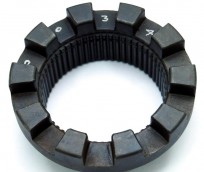
I would not call that a spline joint ! This is a spline joint

220px-Spline-shaft.png


It looks closer to a lovejoy coupling without the inner rubber spider

_-1_1_67.jpg


or possibly a dog clutch.

Dog-Clutch-204x172.jpg


All of these are designed to transmit rotational force.

Some one already mentioned it. Internal threads and a piece of all-thread in between. Drill and tap the tubes on the side and use a set screw or button head screw to lock it. The tube would need to be at least 0.080 wall thickness. 0.100 or 0.125 would be better.
 
Last edited:
OP
J

JDishong

Well-known member
Joined
Jun 2, 2012
Messages
358
Location
Prosper, Texas
I would not call that a spline joint ! This is a spline joint

220px-Spline-shaft.png


It looks closer to a lovejoy coupling without the inner rubber spider

_-1_1_67.jpg


or possibly a dog clutch.

Dog-Clutch-204x172.jpg


All of these are designed to transmit rotational force.

Some one already mentioned it. Internal threads and a piece of all-thread. Drill and tap the tubes on the side and use a set screw to lock it.

Thanks TheOldWizard - 16GA steel tube is too thin to tap threads... I have tried a flow-drill but not enough metal using 16GA.
 

theoldwizard1

Well-known member
Joined
Feb 22, 2011
Messages
43,218
Location
SE MI
Cheap, simple.

Get some rod/tube that fits the ID of the tubes that you want to join. Drill and tap the outer tube for set screws/button head screws. I would use 2 or 3 set screws on each tube.
 
OP
J

JDishong

Well-known member
Joined
Jun 2, 2012
Messages
358
Location
Prosper, Texas
Cheap, simple.

Get some rod/tube that fits the ID of the tubes that you want to join. Drill and tap the outer tube for set screws/button head screws. I would use 2 or 3 set screws on each tube.

I think the inner tube that fits the ID is the simplest approach too. - thanks. I need to test out how many threads will fit in 16GA outer tube. If I can't fit more than 3 threads, I'll just drill through both tubes (inner and outer) and secure.

Thanks
 

theoldwizard1

Well-known member
Joined
Feb 22, 2011
Messages
43,218
Location
SE MI
I think the inner tube that fits the ID is the simplest approach too. - thanks. I need to test out how many threads will fit in 16GA outer tube. If I can't fit more than 3 threads, I'll just drill through both tubes (inner and outer) and secure.

Ahhh ... then it is no longer adjustable !
 

theoldwizard1

Well-known member
Joined
Feb 22, 2011
Messages
43,218
Location
SE MI
I would call it a "slip tang-yoke joint"
I'll buy that !

No way to lock it at its desired length. In order to transfer rotational force the walls of the tube would have to be thicker than 16 gauge.

I would not feel safe with loads that are perpendicular to the tube length unless there was a slip tube covering the joint. The outer slip tube could have set screws to lock the desired length.

The tang and yoke could be designed so that they were identical, just rotated 180°.
 
Last edited:

BD1

Well-known member
Joined
Mar 18, 2007
Messages
4,602
Location
north side
Just for info, if that's 1'' OD, standard 1'' schedule 40 pipe is 1'' ID. Will be perfect to slide over.
 

bullnerd

Well-known member
Joined
Sep 17, 2012
Messages
5,690
Location
Jersey
If your going to manufacture that part in quantity, there's only one way...CNC laser tube cutting machine, no brainer.
 

RobSmith

Banned
Joined
Feb 5, 2009
Messages
562
Location
NSW Australia
JDishong you have not told us what you are making...if we knew that we might come up with an entirely different os simpler way of doing the job.
 
To avoid these ads, REGISTER NOW!
Top Bottom