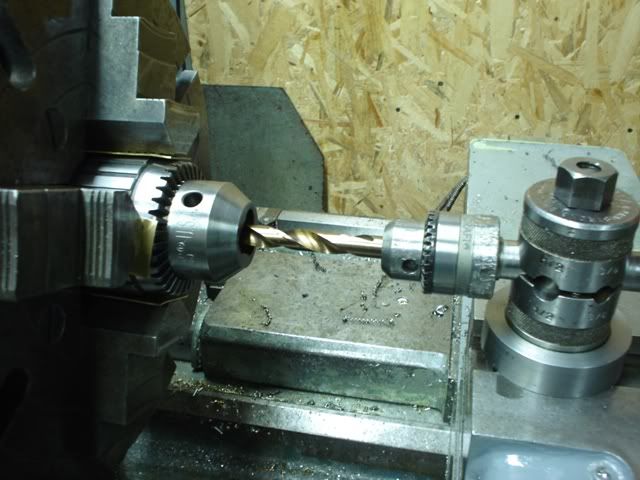
I recently bought a Jacobs #18N 3/4" chuck with a #4 Morse Taper arbor. For my application I'll need to use the chuck with both the existing #4 Morse Taper arbor and a 3/4" straight shank arbor.
Here's the chuck when I bought it with a #4 Morse Taper arbor installed. The smaller chuck to the right is a 1/2" Jacobs with a #2 Morse Taper arbor installed:
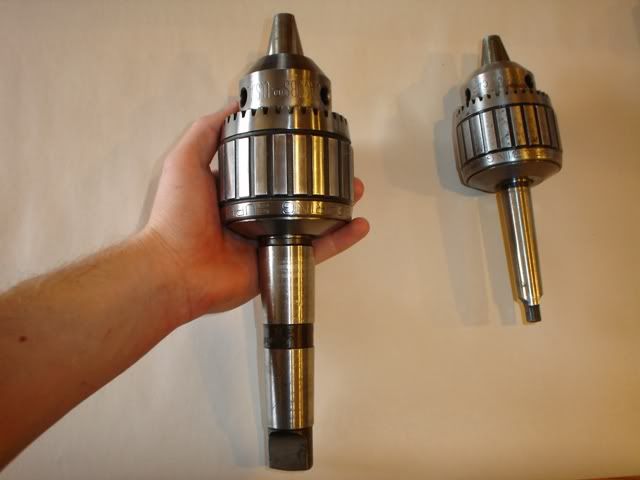
To give an idea of scale, here it is next to a standard 1/2" Jacobs economy drill chuck:

What is a Jacobs Taper?
Before I get into removing the shank, I'll start by explaining just what a Jacobs taper is.
Basically, there are two standards for fixing drill chucks to the drilling machine. The first type of chuck is called a "threaded back" chuck. These are often used on hand drills and small import drill presses. The back of the chuck is threaded, usually 3/8 - 24 or 1/2 - 20 although other standards exist. The chuck screws onto the driving shaft and seats against a shoulder. As the drill spins, the chuck is tightened further onto the shoulder.
Here's an example of a 1/4" Jacobs chuck partially unscrewed from a shop-made arbor:

The threaded back chuck has two drawbacks:
1) The thread does not accurately locate the chuck concentric to the axis of the driving shaft.
2) A threaded chuck cannot operate in reverse, the chuck would simply screw off the shaft.
These drawbacks are solved by the Jacobs Taper. Like the Morse Taper, the Jacobs Taper is a type of self-holding machine taper. Although similar in dimensions to the Morse stub taper, the Jacobs Taper is proprietary to the Jacobs company. Due to geometric advantages, self-holding machine tapers accurately center themselves into their mating socket. They resist torque and disassembly by elastically deforming the socket when assembled, causing the female socket to tightly grip the male taper. Friction alone holds the two together in semi-permanent assembly. Axial thrust only increases their holding power.
Unfortunately, what makes them accurate can also make them hard to disassemble!
The usual method for removing a Jacobs chuck from it's arbor, a drill motor or drill press quill is the Jacobs Removal Wedge. Two wedges are placed between the arbor and the chuck and driven together with a hammer or a bench vise. However, this particular arbor and chuck combination does not lend to this approach as there is very little shoulder on the Morse Taper for the wedges to bear on. Even with a sufficient shoulder, the wedges can be difficult to use in the best of times.
This Jacobs company illustration shows how they are used:

Here's the chuck when I bought it with a #4 Morse Taper arbor installed. The smaller chuck to the right is a 1/2" Jacobs with a #2 Morse Taper arbor installed:
To give an idea of scale, here it is next to a standard 1/2" Jacobs economy drill chuck:
What is a Jacobs Taper?
Before I get into removing the shank, I'll start by explaining just what a Jacobs taper is.
Basically, there are two standards for fixing drill chucks to the drilling machine. The first type of chuck is called a "threaded back" chuck. These are often used on hand drills and small import drill presses. The back of the chuck is threaded, usually 3/8 - 24 or 1/2 - 20 although other standards exist. The chuck screws onto the driving shaft and seats against a shoulder. As the drill spins, the chuck is tightened further onto the shoulder.
Here's an example of a 1/4" Jacobs chuck partially unscrewed from a shop-made arbor:
The threaded back chuck has two drawbacks:
1) The thread does not accurately locate the chuck concentric to the axis of the driving shaft.
2) A threaded chuck cannot operate in reverse, the chuck would simply screw off the shaft.
These drawbacks are solved by the Jacobs Taper. Like the Morse Taper, the Jacobs Taper is a type of self-holding machine taper. Although similar in dimensions to the Morse stub taper, the Jacobs Taper is proprietary to the Jacobs company. Due to geometric advantages, self-holding machine tapers accurately center themselves into their mating socket. They resist torque and disassembly by elastically deforming the socket when assembled, causing the female socket to tightly grip the male taper. Friction alone holds the two together in semi-permanent assembly. Axial thrust only increases their holding power.
Unfortunately, what makes them accurate can also make them hard to disassemble!
The usual method for removing a Jacobs chuck from it's arbor, a drill motor or drill press quill is the Jacobs Removal Wedge. Two wedges are placed between the arbor and the chuck and driven together with a hammer or a bench vise. However, this particular arbor and chuck combination does not lend to this approach as there is very little shoulder on the Morse Taper for the wedges to bear on. Even with a sufficient shoulder, the wedges can be difficult to use in the best of times.
This Jacobs company illustration shows how they are used:
Last edited: